

My “Cheaper” AI Coding Handoff Cost 4× as Much
The first-edit switch wasn’t enough. Here’s what the full technique adds, and what you need before using it.

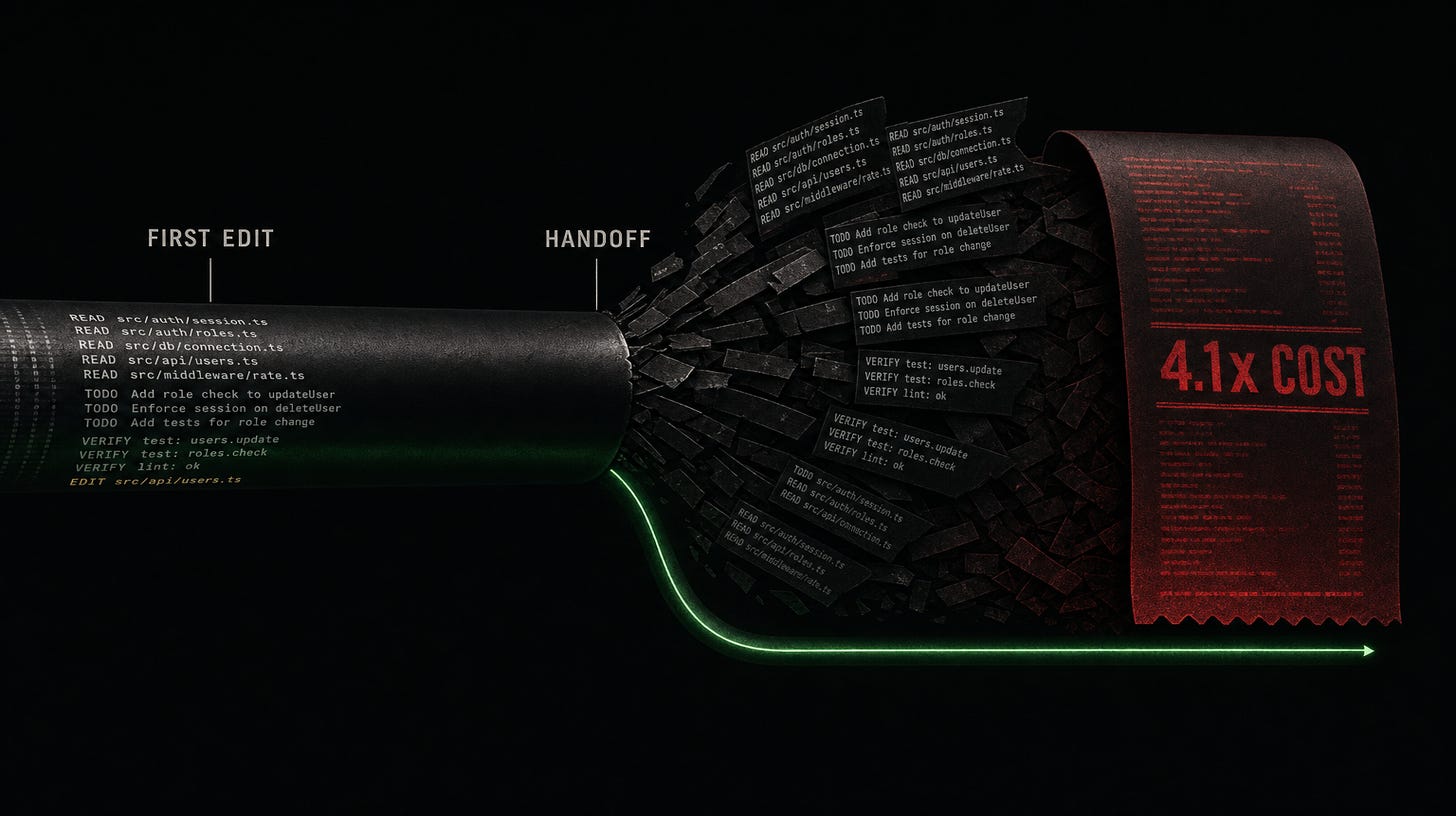
I spent $11.12 to get three passing tests with “cheaper” model routing. Sol alone spent $2.74 to get four.
That was the bargain I was testing: let an expensive frontier model understand the task and make the first edit, then hand the same conversation to a cheaper model. If the first edit marked the point where the hard thinking was done, the cheaper model should have finished the work for less.
The idea came from Stencil's prewalk workflow, which reported 97% of GPT-5.6 Sol's pass rate at 61% of the cost on SWE-Bench Pro. My narrow hypothesis was that the first successful edit, by itself, would carry enough context for Kimi K2.7 Code to finish.
I tested that hypothesis across 18 planned runs. On the five handoff runs that reached the trigger, Sol worked until its first successful file change, through either `edit` or `write`. Then Kimi inherited the conversation and continued execution. One planned handoff run failed in the execution runner before the switch. The shortcut still cost 4.1× as much as Sol alone and produced fewer passes.
That is a test of one stripped-down trigger, not of Stencil's full workflow. Costs below are direct-API-equivalent estimates from recorded token use, not my LiteLLM invoice. The controls I omitted are plausible explanations for the gap, not causes this experiment isolated.
The result
I ran three routes against three deterministic Python repair tasks. Each route attempted each task twice. This small sample can compare these routes; it cannot establish how the full prewalk system performs on other task types.
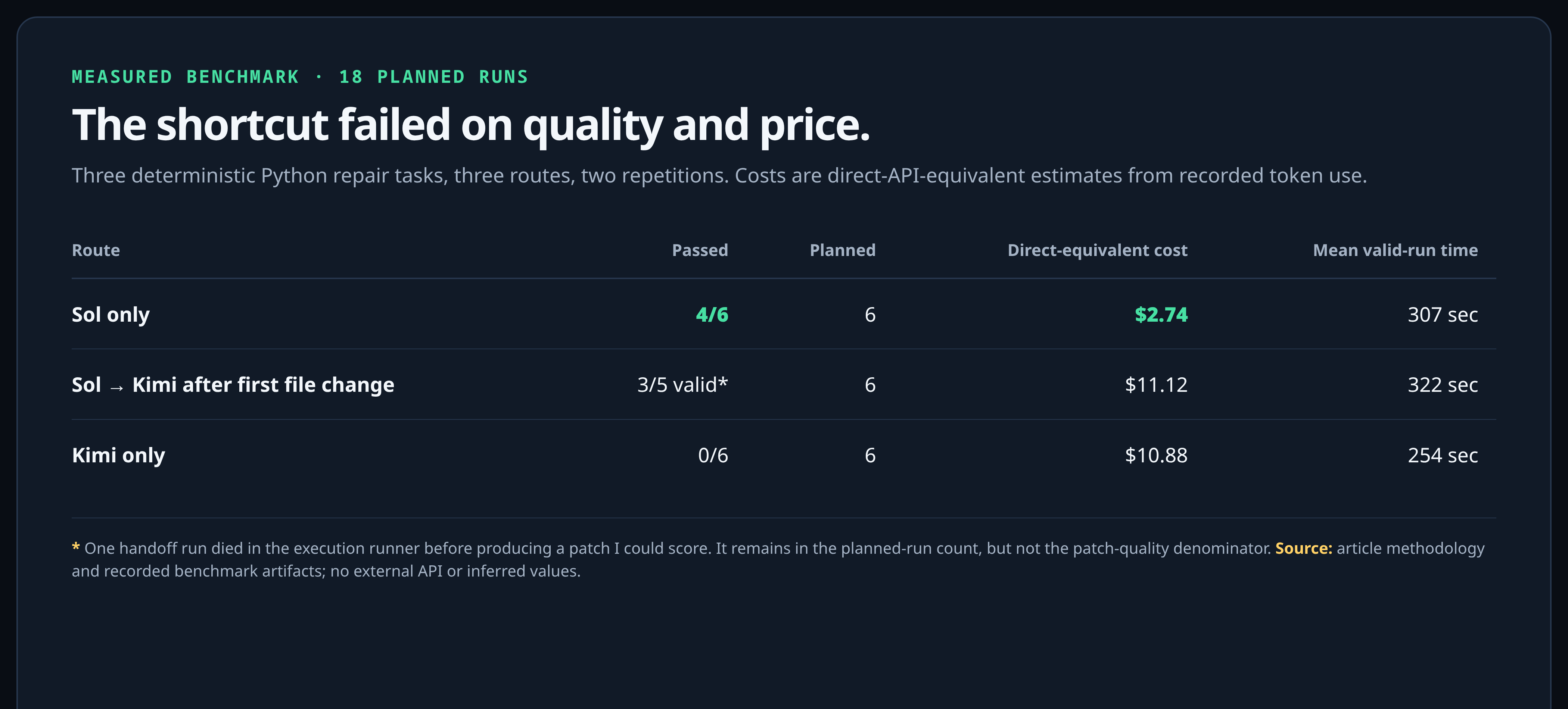
One handoff run died in the execution runner before producing a patch I could score. I kept it in the planned-run count but not the patch-quality denominator.
Sol performed better in this sample: more passes, slightly faster valid runs, and roughly one-quarter of the total cost. The bargain failed on both quality and price.
What I copied, and what I left out
The article that triggered this test came from Stencil. They call the technique prewalk. That distinction matters: I tested one event from their workflow, not the workflow as documented.
Their full workflow does more than switch models after an edit:
1. The frontier model gets a hidden instruction to explore and plan.
2. It creates a short todo list with verification steps.
3. It starts the implementation and lands a valid first edit.
4. The execution runner removes the planning instruction before switching models.
5. The cheaper model inherits the trajectory, todo list, and verification loop.
I only tested the smallest version that seemed likely to carry the value:
Sol works → first successful file change → switch to KimiThe switch happened atomically inside Pi before Kimi's next turn. The adapter preserved Pi's conversation and tool history, including prior file reads and the first edit.
But I did not reproduce Stencil’s bounded todo prompt, instruction pruning, or executor steering. Those omissions define the evidence boundary for the rest of this piece.
I treated the first edit as the useful signal. It proved only that the model had changed a file, not that the remaining work was small or understood.
Where the shortcut failed
The aggregate result hides one useful boundary: the handoff did work on one task.
The handoff passed both transaction-reconciliation runs, cut average time from 243 seconds to 174, and cost $0.63 versus Sol’s $0.76 across the pair.
That task had a narrow repair surface and fast tests. One plausible explanation is that Sol had reduced the remaining work enough for Kimi to finish. Two repetitions cannot establish that as the cause.
The other two tasks show why that distinction matters.
On LedgerLock, Sol passed both runs. The handoff passed one.
On chess reporting, no route passed. The valid handoff run cost $7.52 and failed two of five held-out checks. Sol did not make the first successful write until 658 seconds into that run. That one handoff run alone cost 2.7× Sol’s total spend across all six solo runs.
Across all five successful switches, the handoff happened at 170, 177, 193, 413, and 658 seconds.
In the 658-second run, the switch came too late to save money: that run alone cost 2.7× Sol's total spend across all six solo runs.
If you are routing coding work between models, this section helps you avoid the mistake I made: turning cheaper tokens into a 4× larger bill. Paid subscribers get the five controls missing from my shortcut, the implementation contract, the stop-loss rules, and the telemetry needed to test whether a handoff is saving money.
